




There Is No Charter Calculator
Are your God-given human rights determined by an equation where bureaucrats crunch the numbers?
Here's the reality ...
There is no Charter calculator. No constitutional spreadsheet. No mathematical formula that can tell us precisely when a fundamental freedom ceases to deserve protection.
Yet the Ontario College of Teachers (OCT) wants Canadians to believe that it somehow arrived at exactly such an answer when it ruled that TCDSB Trustee Mike Del Grande was guilty of “teacher misconduct” for opposing the addition of “gender identity” to the board’s Code of Conduct.
Famously now, during a 2019 trustee board meeting, Del Grande used a rhetorical slippery slope argument to make the point that if the board was going to condone one type of sexual lifestyle deemed sinful by the Catholic Church (transgenderism), then it shouldn’t discriminate – it must let in all the sexual fetishes that are out there!
As you’d expect, the LGBT lobby demanded blood, claiming that he "compared" them to pedophiles and other sexual deviants. He did no such thing. Nonetheless, a complaint to the Teachers College (of which he was a non-practicing member) ensued.
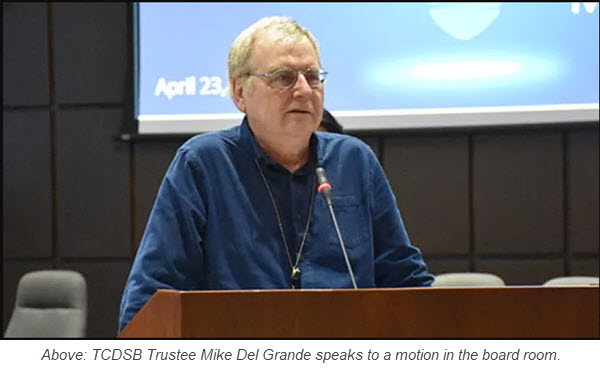
The OCT’s recent verdict that Mike was guilty of "professional misconduct" carried with it an $85,000 fine that he must pay.
The disciplinary rulings against Trustee Del Grande raise a troubling question far larger than one trustee, one board meeting, or one controversial debate.
They force us to ask whether constitutional rights in Canada remain meaningful protections, or whether they have become privileges that regulatory bodies may override whenever they invoke the language of “balancing”.
The OCT openly acknowledged that Del Grande’s freedom of expression under section 2(b) of the Charter was infringed. Yet, after acknowledging that fact, the College concluded that the infringement was justified through something called a “Doré analysis” and therefore acceptable.
That is precisely where Canadians should become concerned.
The OCT’s reasoning relies heavily on the modern judicial fashion of “balancing” Charter rights against “statutory objectives” and against amorphous, almost mystical “values” that supposedly “underlie” the Charter and which have the power to neutralize the actual written text of the Charter.
According to the College, it weighed Del Grande’s expressive freedom against its regulatory mandate and concluded that restricting his speech was proportionate and reasonable! It repeated that conclusion both in its finding of misconduct and in its later penalty decision.
But where is the transparency?
Where is the objective formula?
Where is the measurable standard?
The answer appears to be nowhere.
The College repeatedly invokes the language of "proportional", "balancing", and "public interest". Yet these words do not explain how the conclusion was reached. They merely describe the conclusion after the fact.
To critics like me, this creates the appearance of a process in which the result is determined first, and the balancing exercise is used afterward to justify it.
The language of “balancing” creates the illusion of precision.
It sounds as though constitutional rights are being weighed on a scale, measured to the gram, and compared against competing interests using some objective standard. But no such scale exists.
What exists is the subjective judgment of human decision-makers on the OCT Discipline Committee. Dressing that judgment in technical language does not make it objective.
If the OCT truly performed a constitutional calculation, Canadians are entitled to see the equation.
What numerical value was assigned to freedom of expression?
What mathematical weight was assigned to the College’s statutory objectives?
What formula converted those competing considerations into a finding that restricting Trustee Del Grande’s Charter rights was “reasonable”?
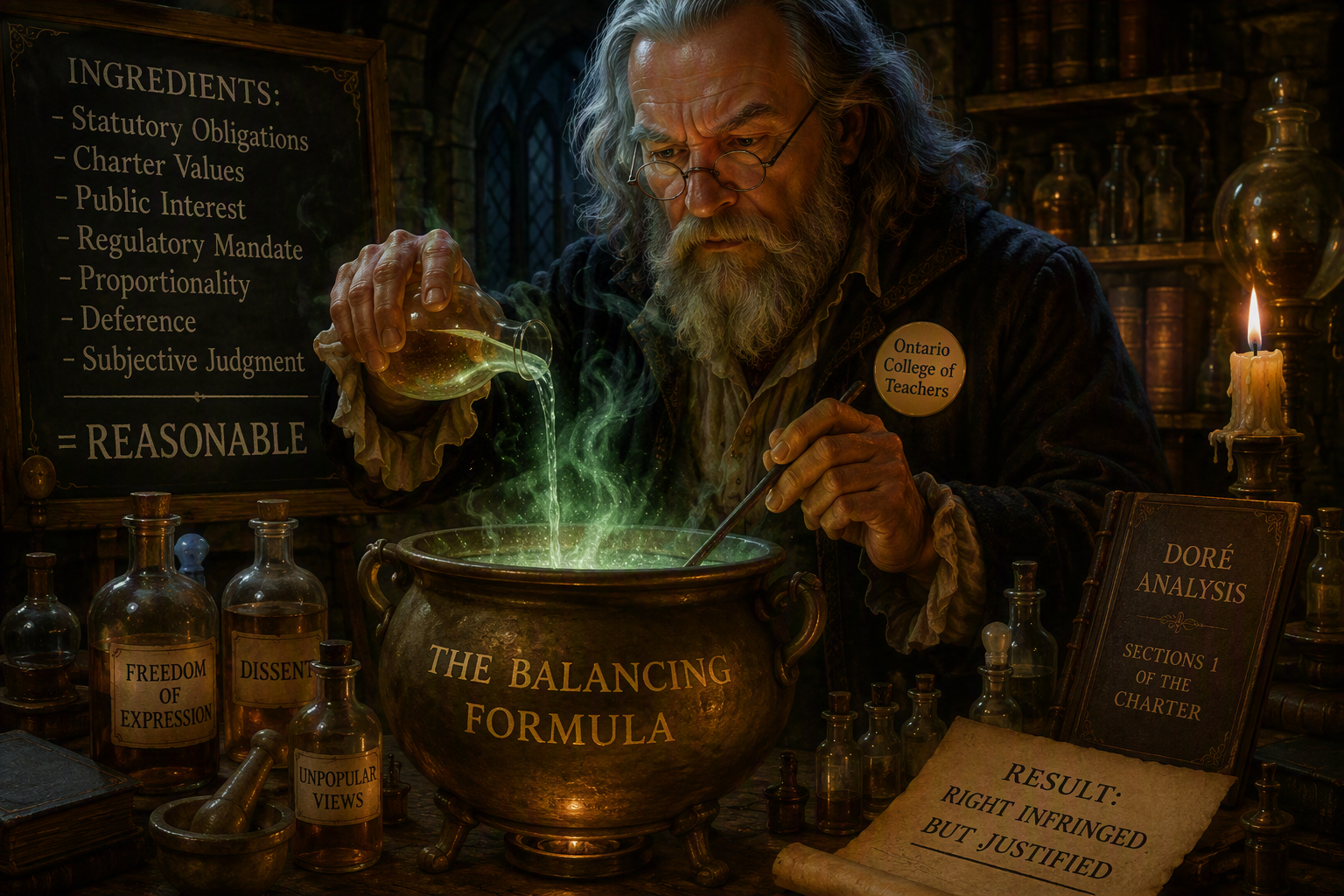
Of course, no such formula exists. No such calculation is even possible!
The outcome ultimately reflects the personal biases of the decision-makers. The real question is whether those decision-makers approached the task fairly, impartially, and with proper respect for a constitutional freedom that is supposed to enjoy the highest legal protection in Canada.
Del Grande argued that he was engaging in rhetorical political debate about a matter of public policy. He testified that his remarks were intended as hyperbole and a “slippery slope” argument modeled on a recognized style of municipal political debate. The College expressly accepted that he was attempting to make a political point and did not find that he acted out of hatred toward “the LGBTQ+ community”.
Yet despite acknowledging those facts, the College still concluded that his manner of expression amounted to professional misconduct!
That decision should alarm anyone who values vigorous public debate.
Political speech has traditionally occupied the highest rung of constitutional protection.
Democratic societies depend on elected representatives being free to make unpopular arguments, challenge prevailing orthodoxies, and use rhetoric that others may find offensive.
If regulators can punish political expression whenever they deem it offensive or insufficiently respectful, then freedom of expression begins to look less like a right and more like a privilege that can be revoked whenever authorities disapprove of what is being said.
Even more troubling is the College’s written suggestion that the restriction on free speech is no big deal since members who object to such restrictions can simply resign from the profession.
That logic turns constitutional rights on their head.
Fundamental rights are not being properly respected if the cost of exercising them is surrendering your career! Nor should professional regulators be casually empowered to place citizens in a position where exercising constitutional freedoms risks professional ruin.
The penalty phase deepens these concerns.
Following the finding of misconduct, Del Grande offered to resign permanently from the College and was nonetheless ordered to pay $85,000 in costs. The College again concluded that these severe consequences represented a "reasonable" limitation on his freedom of expression.
Reasonable according to whom?
That is the question Canadians should keep asking.
Whatever one thinks of Del Grande’s rhetoric, the deeper issue is whether constitutional freedoms genuinely protect dissenting viewpoints when administrative tribunals possess such broad discretion to redefine the limits of acceptable speech.
The Charter of Rights and Freedoms, as part of the Constitution, was intended to be the supreme law of Canada, not a rhetorical speed bump that government-created regulators can drive around by reciting the words “balancing” and “proportional”.
Canadians should be wary whenever officials present subjective judgments as if they were objective measurements. A thermometer can tell us the temperature. A scale can tell us a person’s weight. A calculator can tell us whether two plus two equals four.
But there is no instrument capable of calculating the precise moment when a constitutional freedom ceases to deserve protection.
The OCT wants the public to accept that its “balancing” exercise produced the correct answer. Yet without any objective standard against which that answer can be tested, many Canadians will reasonably conclude that what is being presented as legal necessity is, in reality, little more than the anti-Christian biases of a few woke regulators wrapped in constitutional baffle gab.
If constitutional rights can be overridden through subjective judgments dressed up as neutral analysis, then the greatest danger is not to one trustee’s reputation. It is to the public’s confidence that fundamental freedoms still mean what they say.
When regulators can admit a right was infringed and then declare the infringement acceptable, Canadians should not stop the conversation.
They should start one.
We must demand absolute free speech in political arenas – including trustee board rooms – and on moral matters, without any exceptions or exclusions.
The “balancing act” scam must be driven out of our legal systems once and for all.
In the meantime, please remember Michael has stood in the gap on behalf of all faithful Christian parents and grandparents. He has suffered greatly but complains little… instead offering his pain to our Lord Jesus Christ. Micheal can’t pay this fine alone and he shouldn’t have to. Will you show your gratitude by contributing to his outstanding unjust fines?
Please make a donation at this link here. CLC will direct donations to that cause.